Tuesday, March 13, 2012

podcasts, grave robbers, the rhino, and wash hikes


I’ve had the good fortune to get to know a couple from Canada over the last few winters. Unfortunately it looks like they will probably not be spending any more winters down in southern New Mexico. One state park will just not be the same without them around. This winter Heather and Donald lent me the ‘Lord of the Rings’ trilogy on DVDs. That was a treat. I found the behind-the-scenes features just about as entertaining as the movie. The week before they headed north, we were talking about helping the road miles go by by listening to podcasts. I told them about my favorite, ‘Wait, Wait….’ I was pleased that they were not familiar with it so I know they will be getting some laughs as they work their way up to Toronto. I also mentioned ‘Car Talk’ which they have heard of but never listened to. That show has sure expanded over the years. ‘The Moth’ was another one I thought they might find interesting. Donald and Heather told me about the ‘Vinyl Café’ from cbc.ca. I like it. It’s real down-to-earth. When I went to the site, I came across DNTO (Definitely Not the Opera) which I’m also really enjoying. So now whenever I get into a town where I can access the web, I download the latest podcasts from: Wait, Wait; The World Global Hits; From the Top; Car Talk; The Moth; Vinyl Café; DNTO, and occasionally This American Life and News From Lake Wobegon. Podcasts on my nano get me through any driving I have to do and through necessary tasks that I’d rather not be doing.

I used to think that archeology was pretty cool—all that they find and how they figure out what life was like hundreds of years ago. The last few years I’ve read articles in National Geographic about digs and I’m changing my outlook. Specifically when it comes to digging up graves. Tomb robbing is an acceptable profession and one can actually get a degree in it. There was a recent article about an excavation of a cemetery down in Panama. One burial pit held a chief, his wife, and child. I’m thinking that is SO not right. If I were buried, I would not want someone digging up my bones years in the future. ‘Hey, I’m dead here! Back off! Show some respect!’ Maybe I just have too much quiet time.

I stopped at Oliver Lee one night to break up a drive. I was there once before for a day, not a place I would want to spend time. EXCEPT for the trail, a nice 5 miles to the top of the mountain. In the morning I took a hike up to the line cabin, at the 3-mile marker. I started early so I was in the mountain’s shadow for all of the way up and most of the way down. Early morning can be the quietest time of day. The animals that make a lot of the daytime sounds away from roads are still snoozing or at least still lethargic and there is frequently no breeze. My favorite time of day to be on a trail. I don’t know, maybe one time through I’ll stay a few days just to get in some decent hikes. We’ll see. Not many rigs in the dry sites in January.


Back in City of Rocks again for a few weeks. Love biking loops around the Hydra trail and doing repeats up the overlook switchbacks. Stellar park for getting in shape this time of year. Whenever I hike up the mesa, I strap a lowrider on my pack and throw a thermos, paperback, and jacket in the bag. Real nice place to sit and read while sipping yerba matte for an hour or so. Simple pleasures.


I broke one of my rules. I spent a week at a state park near an interstate. I was told Cabollo Lake State Park does not get a whole lot of RVers since most go up to Elephant Butte. Also I was able to drive there without going on an interstate (rt26 > rt187 and then back to CoR by way of rt152 > rt61). So instead of heading to the Burros, I drove over to Cabollo’s Riverside campground. Had a week of stellar hikes, didn’t see a soul while out hiking. No trails but I went up a different wash or two every day and sometimes managed a loop. Up one wash I came across what might have been an old homestead with a foundation, chicken coop and coral. The lake was so low that there was also good hiking down on the lake bed. One day I cycled up the road to the main campground and was not impressed. It would not have worked, too open for M&M.

I was cycling along one day in CoR past a rig when I noticed the tow vehicle had European plates. Way cool. I stopped and had an absolutely stellar conversation with a couple from Spain. An hour and a half just flew by. Back home their house is 400 years old! They were in the states last year and slept in the back of their van, which they had shipped over. This time they picked up a Casita and will be heading up to Alaska, probably selling the trailer when they are done with the trip. I hope they email me to let me know what they thought of the trip. I think they said they had spent 7 years in China but I could be wrong. They’ve also been to Africa. I asked if they saw a rhino and they both started laughing. They were in a wildlife reserve where one can drive around in their own car with a strict rule about always remaining in the vehicle. Anyway, they were driving along in a small car and saw a rhino off to the left maybe a 1/4 mile, angling to cross the road further along. They stopped the car, turned off the engine and planned to watch the animal as it crossed the road up ahead. When the rhino reached the road—it turned right! They were thinking about a story they had recently heard about some people in a car with one of those heavy accessory bumpers on it. A rhino had approached their car (just like this rhino was doing), hooked his horn in the grill and flipped the friggin’ CAR! Yes, that’s a guano. When the animal got right in front of their car’s hood, it turned its huge head and looked into the car with one eye with this big honkin’ horn sticking up a couple feet. ‘Don’t even THINK about taking a picture!’ Wow, I love talking with people like this. I told them about Tombstone since they want to pick up some western stuff for a relative.

February sixty minutes sixty years—1900 minutes
I have trouble believing how addictive this has become. THANKS again Diana.

Freedom does not come from acquisition. It comes from letting go.
Sogyal Rinpoche


RVwest article ‘Following a free spirit’
FOR INDEX OF POSTINGS GO TO JULY 2006

Monday, February 20, 2012

an old man and the norm


Well, I received my first social security check. Now I am officially an old man. Guess I’ll have to stop trail running, mountain biking, and doing pushups, dips, burpees, and tabatas. Society says that it is important to blend in and follow the norm. Our rate of aging is all laid out for us and it’s easy to see just about everyone follows along without any questions—got the ring right in their nose.


Oh—wait, that’s not me! I don’t do status quo. Guess I’ll just go on doin’ my own thing by not thinking and acting like others my age. Maybe that’s why I joke around more and have more energy.

I see what is typical for people in my age group and I want no part of it. I believe in alternatives to the norm. Often we’re stuck in a rut of doing things a certain way, because that’s the way everyone else does things, because that’s how it’s always done. Because it’s safe. Ellen Glasgow said, “The only difference between a rut and a grave is in their dimensions.” But the normal way of doing things is not the only way, nor necessarily the best way. I’ll continue looking at life my way. I’d hate to be going through my days huffing and puffin’. Been there, done that, didn’t like it, did something about it. Definitely NOT the norm.

January’s sixty minutes sixty years—2135 minutes

Habits are at first cobwebs, then cables. ~ Spanish Proverb

RVwest article ‘Following a free spirit’
FOR INDEX OF POSTINGS GO TO JULY 2006

Tuesday, January 3, 2012

solstice and
silver jewelry of the southwest Indians


Well, no bordeaux or Pink for the solstice. Guano. But—I did find a nice bottle of DaVinci Chianti from the town of Vinci in Italy. It’s probably been close to thirty years since I had a glass of Chianti. Tasty. I even picked up some pasta sauce and parmesan to go with the spaghetti rather than prepare it in one of my usual ways. In the morning, I went out and gave thanks for a couple of hours, mid-day I worked with silver at my bench, and late afternoon went for a brisk walk. A little before twilight I poured a glass of Chianti and took M&M for a walk. Afterwards I sat down to a bowl of brown rice pasta and Vivaldi’s Le Quattro Stagioni. I wrapped up the day with a second glass of Chianti, a book, a feline on my lap, Vivaldi’s Complete Works for the Italian Lute, and Orff’s Carmina Burana. So, once again, the 21st was made special—simply. Happy New Year, Earth, from one who cares.


M&M didn’t want to go out for three days. That never happened before. They always want out, if even for only a few minutes. They did not even want to sit out in their window cage. Never did figure out why.


Many people enjoy silver jewelry of the southwest Indians. I thought I’d post some of what I know about it. Years ago I did quite a bit of research and put together a PowerPoint presentation. I pulled this entry from parts of that file.

Might as well start a little further back. People first mined silver for jewelry in the Bronze Age, 2300-1200 BC (Is this too far back?!). Silver was pretty easy to find all over Europe and West Asia. The big problem was, silver ore (the rocks that had silver in them) generally also had lead in it, so that lead mining and silver mining were the same thing. But lead is not the healthiest of substances, so the men who were mining the silver were also being poisoned by the lead. Most lead-and-silver miners died of lead poisoning in two or three years. Because of this, most free men wouldn't work in the mines, and so they forced slaves to work in the mines instead. What a concept.

The Egyptians considered gold to be a perfect metal, and gave it the symbol of a circle. Since silver was the closest to gold in perfection, it was given the symbol of a semi-circle. Later this semi-circle led to a growing moon symbol, probably due to the likeness between the shining metal and the moon glow. Silver is the most lustrous/reflective metal.

Today, the 300 or so silver mines in the world use both underground and open-pit mining. Of these mines, very few are producers of pure silver. Rather, most silver (80%) is produced as a bi-product of other ores such as copper, lead, gold, uranium and zinc. The deposits in Canada, the former Soviet Union, the U.S, and Mexico account for more than 80% of the world’s silver resources.


The word ‘smith’ means ‘to smite,’ to hit or strike. Basically it means that hammers are used for shaping. A traditional silversmith frequently begins with a thick piece of metal called an ingot. The ingot is hammered until it is thin. Traditional silversmithing is fabricating large objects from silver using hammers and various stakes—chalices, serving trays, silverware, vases, etc. and repairs. NOT techniques used by the Indians in the southwest.
You are all familiar with the work of a famous traditional silversmith from the 1700’s. And what is he known for? Riding around on his horse one night, shouting and waking up all his neighbors. This photo shows some of Paul Revere’s work (from his day job).

Contemporary silversmithing is really ‘goldsmithing’—making small works of art out of precious metal.

Indian jewelry is recognized worldwide as a dynamic and stellar art form indigenous to the culture and heritage of the Indian tribes in southwestern United States. The art style is almost all hand-crafted work (or, at least it was).

Can’t talk about southwest jewelry without saying something about turquoise. Turquoise found in the Hohokam excavations in southern Arizona dates back to 200 BC. Prehistoric Indians mined turquoise and turned this mineral into jewelry, primarily drilled beads and other hanging ornaments. Turquoise is a semiprecious, opaque mineral composed of hydrated copper and aluminum phosphate—one reason it is found in copper mines. The ‘sky stone’ is an ancient talisman for health and happiness. It’s typically greenish-blue. Stones with more copper content appear bluer, while those with less copper and more iron are greener. Sometimes it has a rock matrix and varying shades of gray, brown or black veining due to inclusions or oxide stains. Bisbee turquoise is known for its dark matrix. Quality varies. Turquoise from the Sleeping Beauty mines in Arizona generally rates very high. Turquoise found in excavated mounds east of the Mississippi have been analyzed and proclaimed to be from out here. That’s pretty cool. It shows the existence of trading in the lifestyle. It also provides a glimpse into probable status levels of the people.


Okay, here we go. It is generally believed that the Spanish colonizers of the Southwest purposely kept the techniques of metalworking from the region's native peoples. Kind of understandable (Here, let us show you how to make metal arrowheads that you can then shoot at us.). Southwest Indian jewelry can all be traced back to one Navajo, Atsidi Saani (which in English means Old Smith). Atsidi Saani learned the art of the blacksmith, working with iron, from a Mexican named Nakai Tsosi near Taylor Mt, in AZ in the 1850's. Atsidi Saani had hoped that by learning the trade he could make and sell the silver bridles and headstalls that the Navajo Indians were buying from the Mexicans at that time. He applied his metal working techniques, as appropriate, to silver, and he began to teach his four sons and others in his family the silversmith trade.

Navajos were taken on the ‘Long Walk’ in 1864 to Fort Sumner and then confined to the Bosque Redondo (Round Thicket) reservation on the Pecos River until 1868.
When Navajo people returned to their beloved mesas and canyons, their new, more settled way of living led to many changes. Among other things, as they were no longer nomadic, they had greater opportunity to learn from each other. The Navahos had long admired and used metal ornaments and horse equipment. They had used brass and copper wire to create bracelets and coins to fashion buttons.


In the early years, between 1870 and 1920, tools were crude. Smiths improvised and created their own crucibles and bellows. For abrasives, they used powdered sandstone, sand, and ashes. A smith may have only had a hammer, large rough files, handmade stamps, a slab of rock for soldering and annealing, and a length of scrap railroad track for an anvil. Smiths did not have dividers, squares, or rulers—symmetry was by eye. Casting molds were carved out of tuff, a volcanic ash similar to pumice. The dust is very fine. The molds would crack after less than a dozen pourings so sometimes the mold would be carved out of hard rock. It was much harder to do but the mold would last indefinitely. Early smiths sat cross-legged on the dirt floor of their Hogan or outside.

Silver was obtained from silver coins (silver dollars, fifty cent pieces, and quarters), which were melted down for casting or hammered flat and annealed. The decade of the 1870s had been a time of experimentation, of mastering the fundamental skills of turning silver coin into articles of adornment.
The 1880s saw an expansion of both in the number of objects created and in the variety of their shape and decoration, and this development continued in the 1890s. This time is called the Classic Era.
In 1890 the US government forbade use of American silver dollars by silversmiths. Guano. The Mexican peso soon gained new favor among smiths because of this and it also had a higher silver content than American coins (95% as opposed to 90%) so it was softer and easier to work with. Can you guess what happened next? Yep, the Mexican government later forbade the exportation of their pesos. Hard to work with silver when there’s no silver.

Often a local trader would give the Navajo smiths silver in the form of candlesticks, teapots, etc to melt down for their work. In the 1880s, traders took advantage of the new market with silversmiths and began selling tools—pliers, drawplates, sand paper and most significantly, small fine files. They also sold or traded silver slugs. Each slug weighed an ounce and was approximately 1½" square and about 1/8" thick. These slugs where hammered flat and fabricated into a finished pieces of jewelry.


Navajo women did not begin to make things from silver until 1918. They watched their husbands and started to assist them with some of the more tedious tasks. Some women picked up enough to go into business for themselves. But even today, the men far outnumber women in this craft.


The best known example of Navajo silver work is the wire bracelet. The earliest Navajo work consisted of hammered work with file decoration and hand stamping. Fine files unlocked the gate to a vastly extended field of decoration with more intricate designs. At first, the dies Navajos carved into the ends of scrap iron were copied from stamps used by Mexican leather workers.


There were substantial improvements between 1920 and 1940, which factored into the increased output of jewelry during this period. A gas torch replaced the blowpipe and charcoal. It offered more controlled heat for soldering and annealing. A rolling mill enabled a smith to roll out a silver slug in a fraction of the time it takes to hammer one out by hand. Sheet silver, introduced in the 1920s by the federal Arts and Crafts Board, replaced slugs. And wire was commercially drawn, saving another time-consuming process.

Although the Navajo revere turquoise for its beauty, firmly believing in its magic qualities, in their jewelry, silver is of first importance. Turquoise is used to set off and balance the areas of polished silver. As one way of enhancing silver, Navajos use die work with great skill. A negative die, one in which the design is sunk into the surface rather than raised above it as in a positive die, was made by striking a positive die into the heated end of another steel rod.
You’ve probably noticed that triangle wire is a characteristic of Navajo design, found on rings, buckles, bracelets, ketohs (bow arm guards), najas, and bridle members. It does have a pretty distinct look. I like it.
The early Navajo silver work concentrated on concha belts, bracelets, bow arm guards, buttons, and silver bells made from quarters.
There are designs dating hundreds of years ago that were found etched on the walls of caves that are being used in jewelry that is made today…such as the famous hunched back flute player Kokopelli.
Perhaps the most important technical advance Navajo smiths made during the 1890s was to learn to set stones in silver. A stone is fastened to metal by a narrow strip of silver that surround the stone, gripping it tightly. This bezel is anchored to the ring or other object by soldering—a delicate process and one that requires a controllable source of heat. After the Navajo learned to set turquoise in silver, they started using other stones less scarce than the valuable turquoise: native garnets, jet, and malachite and occasionally bits of abalone shell and even pieces of colored glass were set. Turquoise was scarce initially, until larger modern (for the times) mines opened up sources for it. It then started to be used extensively in jewelry.
One popular technique used to embellish a piece was appliqué—soldering small decorative piece of silver onto it.
Another was repoussage—the formation of patterns in relief by hammering or pressing from the underside. They usually combined this technique with stamping, as each sets off the other.


The best-known type of necklace has got to be the squash blossom necklace. I think one started seeing them in the 1880’s. Some of the early Spanish designs inspired the crescent, the silver naja, and the pomegranate blossom (now referred to the squash blossom) and became key to Navajo jewelry design.

In 1872, Lanyade, a Zuni, learned silversmith skills from a Navajo named Atsidi Chon (Ugly Smith). Chon and Lanyade became friends (maybe stemming from the fact that Lanyade was one of the few Zuni who could speak Navajo). Chon came to live for a year with the Zuni. Chon worked in Lanyade's house and would not let anyone watch him work so the Zuni would not learn how to make things from silver. He felt if they learned how, he would not longer be able to sell his silverwork to them. Makes sense to me. Since Chon was living in Lanyade's house, Lanyade had an opportunity to observer Chon at work. Lanyade later traded a horse to Chon in exchange for Chon teaching him to work with silver. After Chon went back to the Navajo reservation, Lanyade had to make all his own tools. For the first few years, like Chon, Lanyade did not let anyone watch him do silverwork so he maintained his market. Sounds familiar. As with the Navajo, the craft is usually learned, quite informally, from a relative, first by watching, then by helping to do the easier, more monotonous tasks (forming bezels, grinding stones, sanding, etc). This aid was frequently accepted in place of a fee.

The Zuni's long-time preoccupation with stones had an enormous effect on their jewelry. The fundamental interest of the Navajo smith, as stated, is silver. He has an innate understanding and love of silver for itself. Softly gleaming surfaces of the ‘metal of the moon’ delight him. Because Navajos feel the beauty of the metal, their work tends to have weight and substance. The Zunis, by contrast, have an inherited love and understanding of stones. Silver they look on merely as a means to hold stones, or as embellishment to set them off. Their work might be said to be more ornate.


Cluster jewelry might possibly be the most characteristic Zuni motif—frequently the stones were cut into small teardrop shapes. Rows of stones and the needlepoint style share popularity with clusters.


Zuni had been known for their lapidary skills for hundreds of years. They carved fetishes out of rock and made beads. The Zuni artist characteristically creates jewelry crafted from sterling silver, turquoise, coral, jet (fossilized coal [a kind of petrified wood that has formed beneath the sea]), and mother of pearl. Each individual stone or shell is painstakingly hand-cut, press fitted together, sanded level and then polished to form a seamless mosaic of color. The introduction of the emery wheel made the process go a lot faster.


In the 1890s, Zunis started to set stones into their work using bezels. In the 1920s, the Zuni developed their inlay patterns of multi-colored stones and shell in mosaics and channels (stone set between strips of silver).

Zuni work differed from Navajo work in three main areas:
Zuni work is characterized by many individual stone settings
Zuni mainly used the silver as a platform for the stonework—there was less silver and a thinner gauge was used than one would find in a typical Navajo piece
Zuni smiths also made much less use of stamping

The settled Pueblo way of life provided better working conditions than that of the semi-nomadic Navajo, one thing being a permanent forge on a frame high enough so that the Zuni smith could work standing up. The whole design of Zuni jewelry was oriented to the display of gems. Plain areas of silver suitable for stamping were gone. Decoration by die work had disappeared.

Now to my favorite, the Hopi, the last to adopt silversmithing skills.
After the massacre at Awatovi, the Spaniards left the Hopis in peace to live on their remote mesas and cultivate their fields. Thus the Hopis had little chance to envy the silver that bedecked the conquistadores. They were also more of less, out of the loop. They did not move about as the Navajos did, nor were they near Gallup, like the Zunis, so there was not the temptation to go there for trade and to see the sights. They used horses and wagons little. With their agriculture and crafts the Hopis were pretty much self-sufficient.

Lanyade began touring the various pueblos selling his jewelry. While on Hopi First Mesa at Sichomovi, in 1898, he stayed with Sikyatala (Yellow Light) for four months. Lanyade would not teach the Hopi how to work with silver (sound familiar?) but from watching the Zuni work, Sikyatala picked up enough to learn the fundamentals of the art. After the Zuni left, Sikyatala bought some tools and tried his own hand at working with silver, which he sold to other Hopi. As Lanyade was taught by a Navajo and the Hopi taught by Lanyade all the jewelry of the period was Navajo in style. Silversmithing did not catch on in Hopiland as it did at Zuni and among the Navajos. Hopi weaving was big business, supplying not only home demand but also that of Zuni and all the Rio Grande pueblos. And because both weaving and silversmithing among the Hopis are masculine crafts, they compete for the time of the men, who must also labor in the fields and take part in lengthy ceremonials. Among the Navajos, it is the women who weave and the women and children who care for the flocks; the men are comparatively free. Hopi silversmiths worked at their craft only in the winter, when they were not needed in the fields.


In 1938, the Museum of Northern Arizona in Flagstaff, working with Hopi silversmiths, Paul Saufkie and Fred Kabote, began a program of developing a style that was exclusively Hopi. The work was interrupted by World War II. Following the war, a government grant helped the Hopi Guild with a silversmith training program. A Quonset hut was set up and the first class started in 1947 with thirteen men. Casting and overlay were taught as well as basic silversmithing. Students used copper to learn on, then silver as they became more competent.
The ‘overlay’ technique they created involved the cutting of designs in a heavy gauge silver sheet and then soldering this to a thinner solid silver sheet. The base piece was hand stamped and oxidized. The contrast between the polished areas and those still dark heightens the sculptural quality of overlay. The designs were usually adapted from the pottery shards found in the Sikyatki Pueblo ruins of the 15th and 16th centuries. These pre-Hopi designs were mostly bird motifs. The Hopi Guild also used kachina symbols, animal and clan motifs, and patterns from basket makers, weavers, and potters. One prominent characteristic of Hopi patterns is asymmetrical balance, which provides a startling contrast to the static centering of Navajo and Zuni creations. Another conspicuous trait is fluid curving lines, vividly suggesting movement.


Lawrence Saufkie, son of Paul Saufkie, was awarded an Arizona Indian Living Treasure status. He lives up on Second Mesa on the Hopi Reservation in AZ. The three legged bear is one of Lawrence's classic designs. Michael Kabotie, son of Fred Kabote, is another celebrated Hopi silversmith, as well as a painter and poet. I had the good fortune to take a week-long class with these two a number of years ago. The photo is of Lawrence Saufkie at one of the soldering stations and his home setup is pretty similar. Not exactly high tech nor does it take a lot of tools to make jewelry like this. At the time, Michael was working on a set of panels that would be soldered together and set behind glass.

The commercialization of the craft began in 1899 when the Fred Harvey Company first started to order silverwork made up expressly for Anglos who were passing through on the trains. In the 1920s, with California opening up as a resort center and the automobile being used more and more to transport the ever-growing number of tourists, the demand for Indian souvenirs became insistent and practically insatiable. Much of the silverwork degraded to cheap, fast-produced trinkets, often stamped out by machines. Some Indian jewelry from this time was made from German silver rather than sterling. German silver does not contain any silver whatsoever. It is an alloy of copper, zinc (brass), and nickel. Adding nickel to brass changes it to a silver color (but it looks more like chrome to me). Thinner gauges of silver also became prevalent. This thinning the silver, however, destroyed the important three-dimensional quality of the design. It could look pretty chintzy. Luckily things started to occur in the 1930’s and ‘40’s to bring good craftsmanship and high quality back into the trade.

Each of the distinctive Hopi, Zuni and Navajo silversmiths have a style unique to themselves but over the years, these smiths have evolved from the traditional turquoise based silver jewelry to a more contemporary use of different metals and multi-colored stones. Today's Indian silversmiths are in many cases also goldsmiths and lapidaries as well. They cross tribal design boundaries with a will and with abandon. No longer can one look at a piece and say ‘It's Zuni style so it must be Zuni made.’ The artist of today may incorporate in a single piece all the styles available as well as his or her own innovation. Indian jewelry today transcends tribal styles. Over many generations they have developed their skills, talents and designs into an art form all their own. Many people from all over the world have come to appreciate and love the look of the southwestern jewelry that they handcraft today.

December's sixty minutes sixty years: it was tough making the 1800 this month. I racked up 8 zero-minute days during the first four weeks so it was a scramble to make up those 480 minutes in addition to the 60 minutes a day. The weather was definitely a factor. I don’t like to exercise indoors and in the casita, the floor space is roughly only 2’x7’ with a low ceiling. Movements are somewhat limited. But, the appeal of meeting the challenge finally got through and with a hard last week I bagged it with 1900 minutes. Sure hope this does not happen again.

The license plate read: RETRD—for ‘retired.’ That was not my initial interpretation.

Give thanks for unknown blessings already on their way.
Native American saying


RVwest article ‘Following a Free Spirit’
FOR INDEX OF POSTINGS GO TO JULY 2006

Tuesday, December 6, 2011

disaronno, blue cover, eton, notebook,
a fisherman, and sandbags


December’s here and that means my annual bottle of Disaronno and Grand Marnier. With the winter solstice approaching, I’m searching for a bottle of bordeaux (fat chance). I should have planned ahead and picked up a bottle while up in Moab at the state liquor store. Next year. Maybe I’ll luck out and at least find a bottle of Pink.


When I was at Siscily’s place in Chama, I noticed she had painted her propane tank covers on her casita. It looked good so I asked if I could copy her idea. She will no doubt be painting polka dots on her cover but I’ll be leaving mine like this.


My solar powered eton radio died so I ordered this new model. I don’t use the radio all that much but the weather band comes in handy from time to time and I definitely use the LED flashlight.

The last couple of weeks I’ve been reading my road notebook. It’s just about full and I will be starting a new one in January. Back in my February 2008 entry ‘the lifestyle—what it’s like to live like this,’ I recommended that one might want to keep a road notebook for making entries on the days you move from one camping spot to another and the kinds of data that might prove useful. Anyway, it’s been a hoot reading the notebook. I had forgotten what my thoughts were like back on my first day on the road and all the various occurrences over the years. I also had wanted to make note of miscellaneous data to add to the new journal in case I get back to certain areas.
Useful data to enter in the road journal: day’s mileage, route, how steep the roads were, what the dirt roads at the end of the drive were like, GPS coordinates, the camping spot, thoughts on the drive, and whatever. Make notes on roads, trails, and other things to check out in the area and anything that mighty be helpful to look back on if you come through that way again or if you want to provide someone with specifics.


Last year I got down to Brantley Lake State Park in early December (early for me to be that far south) and noticed how low the water was. When I asked about it I was told they let water out in the fall for Texas. There was great hiking down on the lakebed so I wanted to get to Brantley early so I could do more of it this year. I needn’t have hurried. The lake never filled back up this year. I took the first photo last year and the second photo is of the same boat this year. All this green growth in new. There are even new creatures out on the lakebed.


I sold two of my silver pieces in the last month. They are going to be holiday gifts. Now that winter is here, I’m back in the NM state parks (the only thing that enables me to do this is I choose the more out-of-the-way parks) thoroughly enjoying indoor hot showers. For eight months of the year taking outdoor sun showers is generally no problem but there have been days in November when I was ready to go conventional. Anyway, when it’s not too cold or windy, I have my bench set up outside. People see me working with silver and come over to have a look. If they ask to see completed pieces, I’ll bring out my display case.

I couldn’t find where this story originated. I’ve come across it a couple times. I like it; it goes along with my conception of simple living. The story is called, ‘The Mexican Fisherman.’
An American investment banker was at the pier of a small coastal Mexican village when a small boat with just one fisherman docked. Inside the small boat were several large yellowfin tuna. The American complimented the Mexican on the quality of his fish and asked how long it took to catch them.
The Mexican replied, only a little while. The American then asked why didn’t he stay out longer and catch more fish? The Mexican said he had enough to support his family’s immediate needs. The American then asked, but what do you do with the rest of your time?
The Mexican fisherman said, “I sleep late, fish a little, play with my children, take siestas with my wife, Maria, stroll into the village each evening where I sip wine, and play guitar with my amigos. I have a full and busy life.” The American scoffed, “I am a Harvard MBA and could help you. You should spend more time fishing and with the proceeds, buy a bigger boat. With the proceeds from the bigger boat, you could buy several boats, eventually you would have a fleet of fishing boats. Instead of selling your catch to a middleman you would sell directly to the processor, eventually opening your own cannery. You would control the product, processing, and distribution. You would need to leave this small coastal fishing village and move to Mexico City, then LA and eventually New York City, where you will run your expanding enterprise.”
The Mexican fisherman asked, “But, how long will this all take?”
To which the American replied, “15 to 20 years.”
“But what then?” asked the Mexican.
The American laughed and said, “That’s the best part. When the time is right you would announce an IPO and sell your company stock to the public and become very rich, you would make millions!”
“Millions—then what?”
The American said, “Then you would retire. Move to a small coastal fishing village where you would sleep late, fish a little, play with your kids, take siestas with your wife, stroll to the village in the evenings where you could sip wine and play your guitar with your amigos.”

Like I said, I like the story. But, I find it sad. Most people just don’t get it. Thankfully I’ve never had the status quo ring embedded in my nose.

November’s sixty minutes sixty years: nailed another month with 2030 minutes.
THANKS Diana for your sixty sixty challenge. It’s hard for me to believe how much it has improved my overall health. Prior to taking this up in July, if I didn’t exercise early in the morning, I generally bagged any exercise for the day. But now, if I don’t go out and give thanks in the morning, at least I go out for a brisk walk later in the day. After getting through the first month, now it’s, ‘I have to get in my sixty minutes!’ Not bad. A focus on health should always be a part of one’s mindset.

So, last year I got into medicine ball exercises (using a dumbbell); a stellar way to tone the body. And this year I’ve gotten into Diana’s sixty minutes sixty year challenge, tabatas, brisk walks, and stretching. Not bad since next month I will officially be ‘an old man.’ Last month I’ve added sandbags. For tabatas, I researched dozens of body-weight and light dumbbell exercises. I had no idea there so many to choose from. It’s all come a long way since my high school PE classes. Anyway, one site I’ve been gathering data from covered a few sandbag exercises. Oh man, this is SO cool. After doing a google search for ‘sandbag exercises,’ I now have four pages of exercises to play with and use in my tabatas and on their own. I acquired three different bags differing in style and size and filled them with different amounts of sand. The small army surplus duffle is presently the most fun. One reason I like using sandbags (besides being ‘different,’ which always gets my attention) is that the movements seem to be more ‘real life’ (some more than others), movements used in everyday activities as opposed to the movements using barbells and weight machines. To improve physically, one needs to keep throwing the body curves, or it quickly learns to adapt and starts to coast along. Definitely not a good thing as we get on in years. I’m looking forward to using this new medium in the coming months (although I’m getting some strange looks from people out walking their dogs [not that that’s new]).

December humor— Chicken Little
One day the first grade teacher was reading the story of Chicken Little to her class. She came to the part of the story where Chicken Little tried to warn the farmer.
She read, "....and so Chicken Little went up to the farmer and said, "The sky is falling, the sky is falling!"
The teacher paused then asked the class, "And what do you think the farmer said?"
One little girl raised her hand and said, "My grandpa’s a farmer and I think he’d say something like, 'Holy Sh*t! A talkin’ chicken!'”

I wonder what I’ll choose for next year’s monthly wrap-up. So far I’ve covered: Night Sky, Full Moons, and Humor. Whatever it is, I’ll probably come back in 2013 with another year of Humor. I’m just havin’ way too much fun.

“One thing you can’t recycle is wasted time.” Anonymous


RVwest article ‘Following a Free Spirit’
FOR INDEX OF POSTINGS GO TO JULY 2006

Monday, November 14, 2011

small world, coyotes, running of the bulls,
IZ, salmon run, an empty park, and fresh cup


Sometimes when I’m camped in a nice secluded spot miles back in from the asphalt, the world seems to grow smaller. At such times ‘the world’ is easily defined and it’s boundaries clear. I can feel this when Nature is coming on strong. Maybe I’m running down a trail trying to get back to camp as the clouds are darkening and there’s the sound of thunder off in the distance. Or I’m in my camper as the wind is screaming like a banshee or it’s pouring buckets. The same feeling exists at more gentle times. I might be sitting around a small fire, taking a mug-walk, a bowl-walk, out walking with M&M, sitting under the awning during a warm summer drizzle, or sitting inside watching the snow. Sometimes it’s more sensory. It could be the fragrance of the sage I threw on the fire or the feel of an early morning fog lifting off a glass-smooth pond, the call of an owl or coyote. I can open up to the rhythms and tempo of the natural world—sunrises and sunsets, moonrise, the sound of the wind in the trees, and the flowing water of a mountain stream. It all seems to gradually seep in as awareness expands. It’s like a re-connecting with the simplicity of life. I’m thankful that I can live like this for most of the year. Hopefully, I’ll come up with a way in which I can experience it for even more of the year. As of now however, winters, are pretty much a write-off, but there are other aspects that make the time somewhat pleasurable.
Many don’t understand why campgrounds, the grandiose, and the ‘sights to see’ don’t do much for me. Different strokes. I’m basically content with how I live. Maybe I have a low threshold of satisfaction.


Often I hear a coyote’s call from out in the desert. A sound I enjoy listening to. Other times I hear a pack of coyotes yipping wildly in unrestrained excitement. This sound I don’t care for so much. The pack is celebrating the death of some unfortunate creature. It is not exactly the semi-romantic howl of the wild people most often associate with the animals. It is a frenzied, hysterical cacophony of voices that precedes prey being ripped apart and devoured by the pack. I don’t know, maybe there is too much time to reflect on what I see and hear in this lifestyle.

Well, it’s almost time for ‘the running of the bulls.’ Nay, you say—that’s in July. I say, Ever go shopping between thanksgiving and christmas?

If you have not listened to Israel Kamakawiwo'ole singing, ‘Somewhere Over the Rainbow/What a Wonderful World,’ check out this link:
http://www.youtube.com/watch?v=V1sj2gQJIKI
Did you catch the two transitions?

Whenever I’m in the Chama area I spend time at Paul’s place down in Tierra Amarilla, the 3 Raven’s Coffee House (pictures and story in my December 2009 entry). Right from the get-go it was a fabulous place (well, after ten years of work) but somehow he manages to improve upon it every year. The 3 Ravens got written up in this year’s October issue of Fresh Cup, the magazine for Specialty Coffee and Tea Professionals (www.freshcup.com). Way to go Paul. Can’t see how he can top this but he probably will. Also, remember that Paul is a drum maker. If you are interested in a custom wooden drum, Paul is the person to get one from. His wood shop takes up a good portion of his building.


I saw Siscily when I was passing through Chama. Remember she used to be a ranger at Heron Lake state park. She still runs a kayak rental business in the summer. I was invited over to her place one night for dinner. A few of her friends and Paul were there and we sat around a fire and drank cabernet sauvignon, ate, talked, and told a few joke. A good time. I might enjoy stuff like this more than most since I don’t get a chance to do it all that often. Siscily also stopped by my site a couple times and brought me home grown tomatoes and some wild apples. There is an apple tree next to the visitor center in town.
One morning I had a nice talk with Anthony, the superintendent of Heron and El Vado. A good guy who is very knowledgeable about the area. He grew up in Chama, went off to college, came back, and worked his way up through the park system. He initially stopped by my site to tell me about the closing of Willow Creek for Halloween. They set up quite a popular event in the campground and have been doing it for the past three years or so. Willow Creek reopens afterwards but then its almost snagging season. Not a time to be staying in Heron.


Whenever I stop at Heron Lake as I head south, most mornings I run the trail. I thought I covered all of it, from the visitor center down to El Vado. The other day, Siscily told me the park had a 3-mile trail from the visitor center to the east meadow. Yep, I had to go check it out. Not bad, but my favorite section is still the Salmon Run Trail section. It’s even better now. They blocked off some sections of the old cart path and routed runners/hikers/mountain bikers onto some nice single tracks.

I met a great couple one morning while I was out on the trail. They’re from TorC and were staying in the Brushy Point cg. They had a small, older 5th wheel but, like me, they also have the camper mindset. I rarely come across people like this. Just about all of them are into RVing. We had a good talk. Things like this can make my day.


I never stopped at El Vado as I meandered south so this year I pulled in to see what it was like. When I got there, there was not a single rig in the park. My kind of place. I stayed there for a week and a half and for most of my stay, I was the only camper. Way cool. It was nice having an electric hookup but it was back to the sun shower bag. Every other morning I ran or hiked the Rio Chama trail and most afternoons took M&M for a walk. Jack, a camper with a Fleetwood/Coleman Evolution E1tent trailer pulled in one day. I was really surprised how much room there was in his rig. The box was only 10’ but the inside seemed twice as big as my casita. We had a good time one evening sitting around his campfire exchanging stories. Not bad.

I was planning to leave one Wednesday but noticed in my pocket at-a-glance that it was ‘Day of the Dead.’ Sounded like it was not a good day for being out on the roads so I waited one more day. As always when heading south from Chama, I stop at the 3 Ravens Coffee House for a mug of Paul’s high octane. One mug and I’m good for the whole day! Also, as always, I stocked up with supplies at the La Montanita Food Co-op in Santa Fe. It’s easy to get to and there’s plenty of bulk bins and a good selection of sandwiches at the deli counter.

October’s sixty minutes sixty years: nailed another month with 2115 minutes.

Exercise is hard. It’s sweaty. But it’s also a chance for me to get out of my comfort zone and see if I can do more than I think I can. I look at others who always stay in their comfort zone and I just don‘t want to look like them or live these last years as they do. I sure as hell don’t think or act like them. Different strokes—never developed the herd instinct. Exercise is not about getting in a workout on a Tuesday. It’s about adding 20 years to one’s life—active, useable years that one can truly live. For most, this seems to be a very hard concept to grasp, let alone hold any meaning. But I like to get out of my comfort zone from time to time. It adds a little spice to life (not that I’m going to take up bungee jumping).
“You may delay, but time will not.” Benjamin Franklin

November humor—George Washington and the Ax
Teacher: George Washington not only chopped down his father’s cherry tree but also admitted it. Now, Joey, do you know why his father didn’t punish him?
Joey: Because George still had the ax in his hand?

bonus humor
This misprint is from a Michigan publication, InTune: “Parents are encouraged to stay throughout the concert and not to heave at the end of their child’s performance.” Oops!

The first wealth is health. Ralph Waldo Emerson


RVwest article ‘Following a Free Spirit’
FOR INDEX OF POSTINGS GO TO JULY 2006

Thursday, October 13, 2011

art deco, on the rim, flaming cow sh*t,
check the water, nasty body fluids,
it's a hard life and extended time off the grid


Ah, simple pleasures—a cold glass of water, a book, and a lowrider in the shade of a juniper. OR
a glass of wine, a book, a feline, and a lowrider with a view OR
a mug of yerba mate, a book, and a lowrider with a view
This lifestyle has WAY too many choices. This can lead to stress. I’ll endure it somehow.

Speaking of stress, I bet you are sitting there stressing over where the term ‘Art Deco’ originated. The name was coined at the 1925 Exposition Internationale des Arts Décoratifs et Industriels in Paris. It was the predominant decorative art style of the 1920s and 1930s, characterized by precise and boldly delineated geometric shapes and strong colors, and used most notably in household objects and in architecture.
Now you’ll be able to get a good night’s sleep. If not, try an offering to Morpheus.


I finally found a quiet, secluded spot to camp that felt good (how many months did that take?!). It was at the end of a spur road off FR 211 in the Ashley National Forest Uintah Mountains south of the Flaming Gorge area in Utah. Stayed there a couple weeks to recharge. It rained half the days so I gathered quite a bit of firewood and kept it under a tarp. I like bundling up and reading by a small fire when it is not too blustery. M&M and I had some stellar walks just about every day. We could go off in any direction to make a loop. Some afternoons if Meadow was kind of mopey, she would look at me and meow. I would ask her if she wanted to go for a walk and she would perk right up and shoot her tail straight up in the air. Spoiled little twit. Even Mesa has started doing this.
While out walking and mountain biking I came across a number of other secluded spots to camp farther down some other spurs that appeared to not get much use. Not bad. I’ll have quite a choice if I come back to this area. Puddles were iced over a couple mornings and I had to break out my winter sleeping bag. It’s WAY too early for this.
When I was pulling out, 3 forest service trucks were coming up the road. There was a large notice board at a junction down the road and I stopped to read the papers. The forest service was starting their fall burning with 1,500 targeted acres. Some being where I was camping. Good timing.


I planned to scoot into one of the campgrounds along rt191 to fill up my water jugs but the three I passed were already locked up for the winter. I continued on to Vernal and stopped at the forest service office to ask where some places were in town and to fill the Reliance jugs. Called some friends while I had phone coverage but I only managed to talk with one of them. This lifestyle has a few drawbacks. There was a BLM road and a forest road south of town off rt191 that I wanted to check out for a spot to camp but neither worked out. I kept on to a spot south of Wellington that I was familiar with. I REALLY don’t like driving this much in one day.


I stopped in Moab and had lunch with my friend Lisa at the Love Muffin Café. GREAT little place. We sat outside and ate some tasty wholesome food. Lisa and Glen were out of town when I passed through last fall so it was a treat to touch base and catch up. Glen gave me a stellar suggestion for another area in the rim country south of Moab to check out. THANKS Glen.


I came across a nice isolated spot to camp on the rim. The weather was warm and sunny so I pretty much went about each day in boxers and Tevas and from time to time a sun hat. Sure wish life were more complicated. I hate this concept of simple living. (^_^)
While down in the rim country, I had to go back to my summer bag and leave all the windows and two roof vents open at night. Most change their bedding, between light and heavy, by the season. I seem to be changing it by latitude. Oh well, each day I just try to deal with it all.


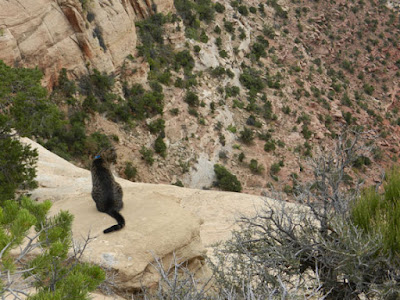
I had an urge to head south to New Mexico WAY too early this year. Don’t exactly know why, maybe the poor camping spots this summer. I guess I’m just spoiled. If I remember right, I don’t generally get to southern Utah until the end of October or early November, NOT September. When I got to the rim country however, I just wanted to stay there. It just feels so good this time of year. Stellar views with plenty of places to hike down on the rock and enough red dirt roads for mountain biking.
This is one of those areas where the stars seem to come down to the horizon, 360. Two nights around the new moon, I rolled out my exercise mat, poured a glass of wine, laid down on the ground and watched the night sky. M&M would come over from time to time to check on me. As I’ve stated in past entries, I believe once someone reaches 50, they should stop acting their age. And a little regression would be nice.


While trail running this past summer, I kept an eye out for moose and bears. Now I’m looking out for these guys. They’re much smaller than moose and bears but noticeably faster with two sharp pointy parts that are best not to come in contact with—and some real nasty body fluid.


The smell of wood campfires can get old pretty quick. Since I’m back in open range, it’s back to flaming cow sh…, I mean, cowpie fires. I’m thinking about buyin’ a cow.

When I started using the water I got from an outside faucet at the forest service office in Vernal, I found leaf matter in every Reliance jug. Quite a bit of it, not just a few specks. Guano. I put a few drops of bleach in each jug and covered the mouth with a piece of screen when transferring water into my galley jug. I was hoping nothing harmful would start growing in my water supply. Never had this happen before. Now I will be checking EVERY time I fill up the Reliance jugs. So far, I feel fine. All the RVers who use their built-in water holding tank and have not installed a deck plate would not even know if anything, other than water, was in their tank. And it sure would not all come out whenever they drain their tank. I have trouble understanding why so few choose to install a deck plate. It’s a simple procedure and only costs $12. I definitely would not want to be drinking out of a holding tank year after year without looking in there from time to time to see if anything was growing and to give the inside a good scrubbing. Different strokes.


When I come across a secluded place to camp, I frequently stay for a couple weeks and sometimes 3 or 4. But the additional weeks entail making a town run for supplies. I’m working towards nixing the town run so I can stay in one place for a month. Often a town is 30 miles away and at times it can be 60 miles to a town with a decent size grocery store. I’ve been up roads where it has taken me 40 minutes just to get back to the asphalt. I’m talkin’ off the grid here—not in a campground or where there are others camped a few hundred yards away. Well, I guess that’s obvious since I mentioned ‘secluded’. Two 5-gal propane tanks generally last me over a month and for most of the year, a month and a half. I could open the deck plate in my city water tank, take out the bags of grains, nuts, seeds, legumes, and yerba mate and fill it with water—but that is A LOT of weight back there bouncing up and down. It’s not like the weight is over the axle. The holding tank’s location works fine for those who travel the asphalt and stick to graded roads but for rough roads and double tracks damaged by erosion, washboards, and whatnot, all that weight can’t be good for the suspension, frame, and rivets. 15 gallons of water weighs 120 pounds. I’d much rather carry water in the tow vehicle. The frame and suspension can better handle the weight on rough roads. And it’s not like I fly down these roads. Often I’m only going 5-10 mph but even at those slow speeds, everything can really get to bouncin’. Remember I’m going miles on these roads not just a couple hundred yards. This winter I want to look into a 40-gallon water tank that I could carry in the bed of the Dodge. 40 gallons would last me 20 days and I would supplement this with the Reliance jugs that I already have. Sixty gallons of water to cover a month off-the-grid with no town run would weigh nearly 500 pounds (480).
I love living out in Nature and I have so many interests and activities that my times off the grid generally go by faster than I realize, especially if there is a network of trails in the area. That certainly would not apply to most people I meet or hear about; they need to be constantly entertained. Hopefully I’ll come across a place next summer where I can try this. If not, maybe next October in the rim country. But then, this would only be possible if a ranger does not come by and start keeping track of my days. I had that happen once.


I’ve been going out for more walks this month. It’s not something I ordinarily do. I’d rather get my cardio in other ways but I might be getting hooked. I was reading an article about the health benefits of BRISK walking at 15-minute miles or faster. I never walk that fast. Sure was getting a burn in my butt and in my calves, though, if I used proper form. I guess walking for exercise is not as lame as I had thought. But it needs to be at a brisk enough pace to get your heart and lungs working at an elevated level. I need to stop at a high school track at some point, so I can learn exactly what a 4 mph pace feels like. Casey Meyers, author of ‘Walking: A Complete Guide to the Complete Exercise’ is in his seventies and still walks 3 miles most mornings at a brisk13-minute mile pace. Except for City of Rocks, none of the places I’ll be staying this winter offer any decent trails for running but each place does have areas where one can get in an hour of brisk walking without doing circles. Huh. I’m also trying to do a 10-15 minute walk within 15-20 minutes after a meal. It’s supposed to raise one’s metabolism and thus burn more fat. If I don’t feel like a walk—I know for sure that I’m just being lazy or I ate too much. Just call my Porky.

September’s sixty minutes sixty years: must be on a roll, did 1870 minutes—that’s 3 for 3.

As for my September ‘Quad 200’ challenge, not so good. What a dumb idea. I’ve always known to not work the same muscle group (except for maybe abs) on back-to-back days, let alone six days a week and yet I set out to do it anyway. Guess my success with Diana’s ‘sixty minutes sixty years’ and tabata circuits was getting to my head. Too over-confident. I was easily getting in the 200 reps each day, hitting them from various angles using different exercises. My reps, however, weren’t going up; my quads were not getting stronger. Well, duh. Muscles don’t grow on the days they are being worked but rather, on the days when they are resting. When you work a muscle group hard, the muscle fibers tear. You grow muscle and grow stronger as the muscles repair themselves. You have to give them time to do that. One also needs to feed them by taking in enough protein. People say they get enough protein without knowing how much is required let alone know how many grams they are getting each day. Unreal. The RDA for protein is geared to sedentary individuals, not to those who exercise and put some umph into their workouts. So anyway, I bagged the challenge, gave my quads a few days of rest, and shot for 200 reps every other day or two. My reps started to go up. Let’s have another—well, duh!

October humor—Games For When We Are Older
Musical Recliners
Red Rover, Red Rover, The Nurse Says Bend Over
Spin the Bottle of Mylanta
Hide and Pee
Kick the Bucket

bonus humor (if you like cats): http://www.youtube.com/watch?v=_MqHN-4okZ4

Normally, we do not so much look at things as overlook them.
Alan Watts.


RVwest article ‘Following a Free Spirit’
FOR INDEX OF POSTINGS GO TO JULY 2006